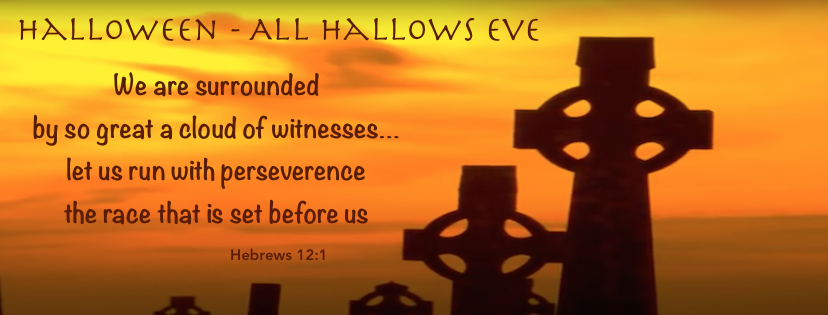
Halloween is a celebration observed in many countries on October 31st. In popular culture, Halloween has become a celebration of horror and is associated with the macabre and the supernatural. [1] Most everybody, at least in the Western world, is familiar with Halloween. We know about the trick-or-treaters, the masks, jack-o’-lanterns, haunted houses, and so on. But this familiarity with Halloween is superficial. That is as true of many Christians as it is of most everyone else. Not a year goes by without a number of believers getting on Facebook, YouTube, other social media platforms, or behind pulpits thundering that they don’t celebrate Halloween because it’s evil. Or they accuse the Roman Catholic Church of Christianizing a pagan holiday, and so forth. As Christians we certainly should not dress up as ghoulish figures or glorify wickedness, but beyond that, is Halloween really evil? Where did it come from? You will be surprised to know that it began as a Christian celebration.
Halloween is, in reality, the eve of the Western Christian feast of All Hallow’s Day. Celebrated on October 31st, it is the beginning of the observance of Allhallowtide, the time in the Christian liturgical year dedicated to remembering the dead, including saints (hallows), martyrs, and all the faithful departed. All Hallow’s Day is on November 1st, and All Souls’ Day is on November 2nd. [2] Halloween has various names but in the interests of consistency we reference just one: All Hallow’s Eve. [3]
Long before Halloween existed, there was another celebration held at this time of year: Samhain, originating with the ancient Celtic tribes who lived in Ireland, Scotland, Wales and Brittany. For the Celts, November 1st marked the beginning of a new year and the coming of winter. The night before the new year, they celebrated the festival of Samhain, Lord of the Dead. During this festival, Celts believed that the souls of the dead, including ghosts, goblins, and witches, returned to mingle with the living. In order to scare the evil spirits away, people lit bonfires and wore masks. [4] When the Romans conquered the Celts, they added their own touches to this festival, such as making centerpieces out of apples and nuts for Pomona, the Roman goddess of the orchards. The Romans also bobbed for apples and drank cider. [5]
In the 700s AD, Pope Gregory III of the Roman Catholic Church founded an oratory (a place set aside for divine worship [6]) in what we now call the old St. Peter’s Basilica [7] for the relics “of all the holy apostles and of all saints, martyrs and confessors.” Some sources say it was dedicated on November 1st. There is evidence that by 800, churches in Ireland and Northumbria (an early medieval kingdom in Northern Ireland and South Scotland [8]) were holding a feast commemorating all the saints on that date. Alcuin of Northumbria, a member of Charlemagne’s court, may then have introduced this date of November 1st in the Frankish Empire. [9]
In the year 835, Pope Gregory IV moved the celebration for all the martyrs (later all saints) from May 13th to November 1st. The night of October 31st therefore became known as All Hallow’s Eve. Eventually the name was shortened to the current Halloween. On November 2nd, All Souls Day is celebrated. [10] Theories vary as to why the holiday was moved to November 1st, but one practical reason could have been to give Christians a holy alternative to Samhain and its attendant days. In any case it is clear that Halloween is not Samhain Christianized. Instead, it was an already-existing Christian holiday moved to that same time of year. It is separate and distinct from Samhain.
By the end of the 1100s, the celebration of Halloween had become one of the holy days of obligation requiring church attendance…and involving such tradition as ringing church bells for souls in purgatory. (Note: We are Protestants and do not believe in purgatory – this is a historical note.) It was also “customary for criers dressed in black to parade the streets, ringing a bell of mournful sound and calling on all good Christians to remember the poor souls.” [11] The Allhallowtide custom of baking and sharing soul cakes for all christened (baptized [12]) souls has been suggested as the origin for trick-or-treating. The custom dates back at least as far as the 1400s and was found in parts of England, Wales, Flanders, Bavaria and Austria. Groups of poor people, often children, would go door to door during Allhallowtide, collecting soul cakes in exchange for praying for the dead, especially for the souls of the givers’ friends and relatives. This was called “souling.” Soul cakes were offered also for the souls themselves to eat, or the “soulers” would act as their representatives. As with the Lenten tradition of hot cross buns, soul cakes were often marked with a cross, indicating that they were baked as alms. [13]
In the Middle Ages, churches in Europe that were too poor to display relics of martyred saints at Allhallowtide let parishioners dress up as saints instead. Some Christians observe this custom at Halloween today. That was fine. As time wore on, though, the holiday of Halloween began to change and become corrupted. Many Christians in mainland Europe, especially in France, believed “that once a year, on Halloween, the dead of the churchyards rose for one wild, hideous carnival” known as the danse macabre, which was often depicted in church decorations. This activity was sometimes enacted in European village pageants and court masques with people “dressing up as corpses from various strata of society,” and this may be the origin of Halloween costume parties. In Britain, these customs came under attack during the Protestant Reformation. [14]
There were other customs associated with Halloween in other areas [15], but we will not address them. It should be clear by now that, despite some serious doctrinal errors and customs coming into play, Halloween is actually of Christian origin and has nothing to do with Samhain and other days associated with that ancient Celtic festival. So how did Halloween become the ghoulish celebration that it is today, with all its association with evil?
The early Puritan colonists in New England did not celebrate Halloween, but the holiday did enjoy some popularity in the Southern colonies. [16] Irish and Scottish immigrants brought their Halloween traditions to America in the 1800s. These traditions merged with existing American customs, shifting the focus from a purely religious observance to a community-centered celebration with parties, games, and autumn festivals. [17] Also by the 1800s, fall harvest festivals borrowed many Halloween elements, and Irish immigrants escaping the Great Potato Famine brought along many more of the customs that remain today, such as jack-o’-lanterns. [18] Early American Halloween celebrations included community gatherings, games, and autumn festivities, with pranks and mischief also becoming customs. The tradition of trick-or-treating developed in the early 1900s in America, evolving from older customs like “guising” in Ireland and Scotland, where people performed antics for treats. [19]
Along with skeletons and black cats, Halloween has incorporated scary beings such as ghosts, witches, and vampires into the celebration. Another symbol is the aforementioned jack-o’-lantern, which we know as a hollowed-out pumpkin carved into a demonic face and lit with a candle inside. The original jack-o’-lantern was made from a turnip. [20] By the mid-20th century, trick-or-treating had evolved into the familiar ritual of giving out candy to trick-or-treaters that we recognize today. [21] It would seem, then, that the way Halloween is celebrated today involves customs imported into America from Europe, including elements of Samhain and the danse macabre. We must not forget, though, that Halloween is actually of Christian origin. With that being the case, how can we, as Christians, reclaim this holiday for the glory of God?
Since martyrs were remembered during Allhallowtide, we could spend at least a small portion of each day, Oct. 31st – Nov. 2nd, even just a few minutes, remembering those who were martyred for the faith, either specific saints or in general. For your information, the Bible refers to all who are born again as saints, not just those whom the Roman Catholic Church has canonized (Romans 1:7, 16:2; Ephesians 4:12; Philippians 1:1). Or you could celebrate Halloween with Christian-type costumes or even costumes that may not be Christian but are not associated with wickedness, such as police officers, firemen, doctors, et cetera.
Christian parents, taking your kids trick-or-treating while dressed up as saints or other non-evil people as just noted is not a sin. You are not getting in trouble with God and you are most certainly not sacrificing your children to Molech. Yes, some believers have actually spewed such nonsense, even from pulpits. By celebrating the traditions in a Christian manner you are not covering up evil. No, you are not going to get demons, either. There are other believers who have said that as well and it is as unscriptural as can be. A number of churches hold trunk-or-treats at the church where parents can take their children to get candy. Often even non-Christians are welcome. Other public venues such as malls, for instance, also have safe Halloween activities. While we are called to be holy, God does not want us to be a bunch of prune-faced, legalistic blowhards who see evil in everything. What person would want to have anything to do with Jesus Christ after seeing Him so badly represented by His people? No, we go about with the joy of the Lord, and that includes reclaiming Halloween.
It is important that we as Christians read our Bible and pray daily. We must know the Bible if we want to know its Author. This also helps equip us to be protected against the foolishness dispensed by misinformed or ignorant believers not just on Halloween but on every holiday. You name it—Christmas, Easter, whatever—there are Christians who are going to bash these as being pagan in origin, claiming it is evil for us to observe them. Educate yourselves. Research the holidays, but get your information from reputable sources. By doing this we were able to present the truth about Halloween in this blog. We strongly encourage you to keep this as a reference, to check out the reference notes below for yourself, and to spread the word: Halloween has Christian roots.
REFERENCES
[1] Wikipedia article, “Halloween.” Retrieved 10/17/2025; slight editing and paraphrasing.
[2] https://www.brittanica.com October 17, 2025, article written and fact-checked by The Editors of Encyclopaedia Brittanica, “Halloween.” Retrieved 10/18/2025; slight editing and paraphrasing.
[3] Wikipedia article, “Halloween.” Retrieved 10/17/2025; slight editing.
[4] https://franciscanmedia.org October 2018 article by Susan Hines-Brigger, “Halloween and Its Christian Roots.” Retrieved 10/18/2025; slight paraphrasing.
[5] Ibid.; slight paraphrasing.
[6] Wikipedia article, “Oratory (Worship).” Retrieved 10/18/2025; slight editing.
Ibid.; slight paraphrasing.
[7] Wikipedia article, “Old St. Peter’s Basilica.” Retrieved 10/18/2025; slight editing.
[8] Wikipedia article, “Northumbria.” Retrieved 10/18/2025.
[9] Wikipedia article, “Halloween.” Retrieved 10/18/2025; slight editing.
[10] Ibid.; slight editing.
[11] Ibid.; slight editing.
[12] Wikipedia article, “Baptism.” Retrieved 10/18/2025.
[13] Wikipedia article, “Halloween.” Retrieved 10/18/2025; slight editing.
[14] Ibid.
[15] Ibid.; paraphrased.
[16] https://www.brittanica.com October 15, 2025, article by Don Vaughn and fact-checked by The Editors of Encyclopaedia Brittanica, “Why Do We Celebrate Halloween?” Retrieved 10/18/2025.
[17] Google: “Search Labs | AI Overview: How Did the Celebration of Halloween Become What it is Today?” Retrieved 10/05/2025; some paraphrasing.
[18] https://www.brittanica.com October 15, 2025, article by Don Vaughn and fact-checked by The Editors of Encyclopaedia Brittanica, “Why Do We Celebrate Halloween?” Retrieved 10/18/2025.
[19] Freespoke AI Overview: “The Change of Halloween From a Religious Observance to a Secular Celebration.” Retrieved 10/18/2025.
[20] https://www.brittanica.com October 17, 2025, article written and fact-checked by The Editors of Encyclopaedia Brittanica, “Halloween.” Retrieved 10/18/2025.
[21] https://www.brittanica.com October 15, 2025, article by Don Vaughn and fact-checked by The Editors of Encyclopaedia Brittanica, “Why Do We Celebrate Halloween?” Retrieved 10/18/2025.
James Burch




Happy Halloween!!! May we spend this time each year, and all throughout the year remembering those who have paved the way before us with the laying down of their lives (martyrs), so we can enjoy the freedoms we have today as being able to have our own Bible in our own language, and the many other great accomplishments they made!